International Seminar Unismuh Makassar-UPSI Malaysia Discusses Why Technology Cannot Replace Teachers
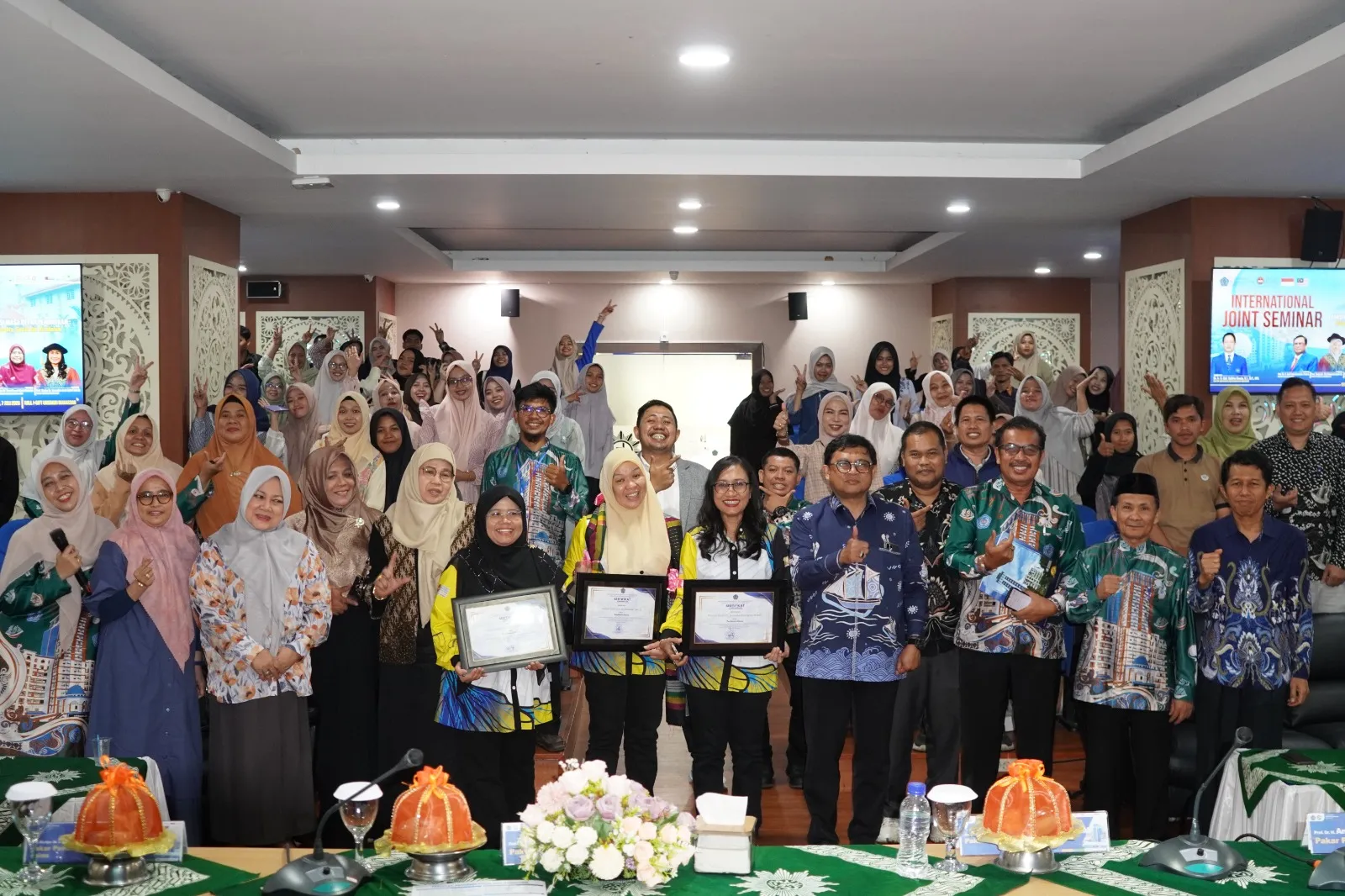
NEWS.UNISMUH.AC.ID, MAKASSAR — Universitas Muhammadiyah (Unismuh) Makassar and Universiti Pendidikan Sultan Idris (UPSI), Malaysia, held an International Joint Seminar themed “Transforming the Future of Education: Integration of Sciences, Social Sciences, and Curriculum” in Hall I-GIFt Unismuh Makassar, Tuesday, July 7, 2026. This event was held to strengthen international academic cooperation through a scientific forum discussing the integration of science, technology, curriculum, culture, and humanistic values in future education.
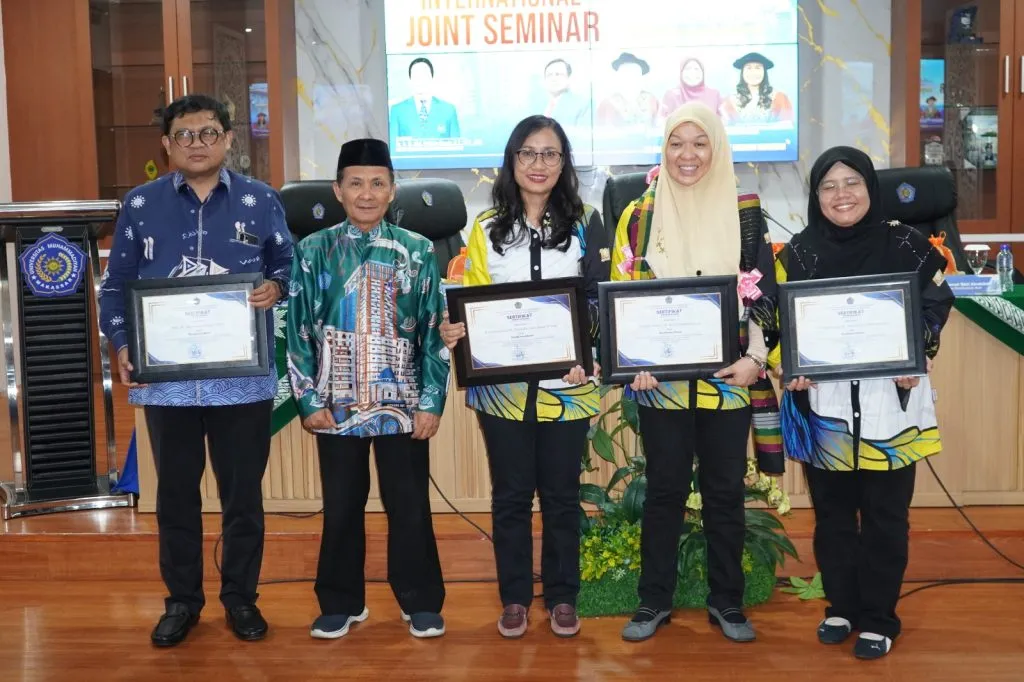
The international seminar was part of a series of visits by the UPSI Malaysia delegation to Unismuh Makassar from July 6–9, 2026. This forum featured the First Vice Rector of Unismuh Makassar, Prof. Dr. H. Andi Sukri Syamsuri, M.Hum., commonly known as Prof. Andis, as well as three UPSI Malaysia academics: Prof. Madya Dr. Norazilawati binti Abdullah, Prof. Madya Dr. Siti Rahaimah binti Ali, and Prof. Madya Dr. Norwaliza binti Abdul Wahab.
The event was opened by the Fourth Vice Rector of Unismuh Makassar, Dr. Burhanuddin, who attended on behalf of the Rector of Unismuh Makassar, Dr. Ir. H. Abd. Rakhim Nanda, S.T., M.T., IPU. In his opening remarks, Burhanuddin conveyed the Rector's apologies for being unable to attend due to a conflicting agenda at the same time.
“It is an honor for Unismuh Makassar to be visited by experts from UPSI. This is a positive sign for the university,” Burhanuddin said during the seminar opening.
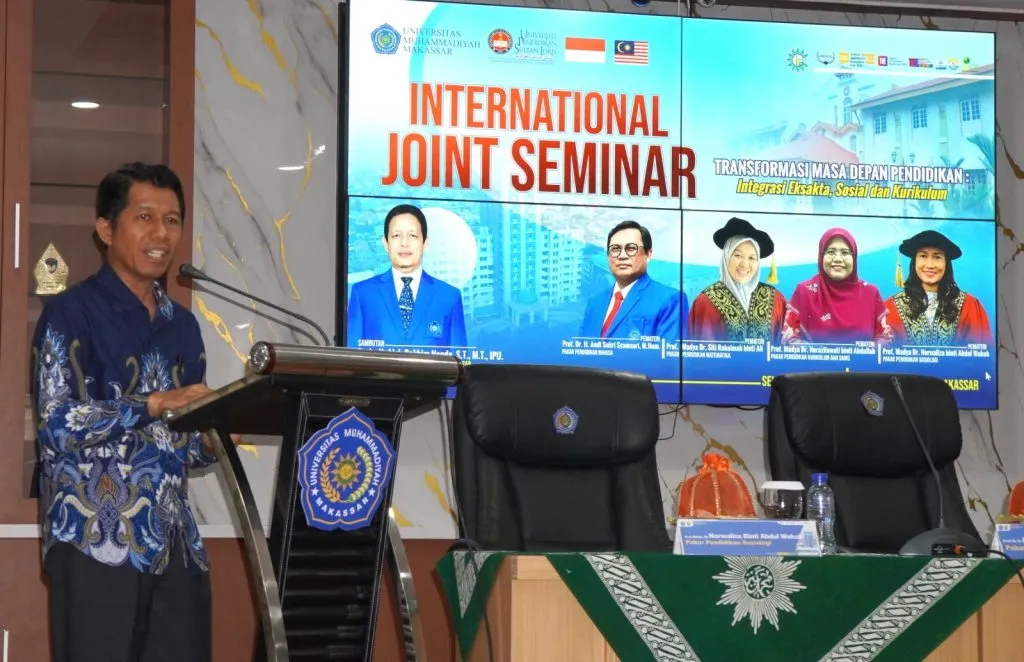
Burhanuddin stated that the visit by UPSI Malaysia academics aligns with Unismuh Makassar's vision to strengthen its international competitiveness. He noted that since the 2024–2028 academic year, the Rector of Unismuh Makassar has outlined a campus development direction toward becoming an internationally reputable university.
He mentioned that Unismuh Makassar has entered the international competitiveness arena in the past three years. Burhanuddin also shared that Unismuh Makassar employs 830 lecturers, with 320 holding doctoral qualifications, or approximately 39 percent of the permanent faculty.
According to Burhanuddin, Unismuh Makassar is currently promoting the enhancement of faculty academic qualifications. One prepared program includes support for doctoral studies, particularly for young lecturers aged 35 and below who will be directed to pursue studies in education, including opportunities at UPSI Malaysia.
“Colleagues here from the education faculties may start making their intentions known now to pursue further studies at UPSI,” said Burhanuddin.
Burhanuddin explained that the event also served as a return visit after Unismuh Makassar's previous delegation had visited UPSI Malaysia for scientific activities. He hoped that the cooperation between the two institutions would not end with a joint seminar but would continue into research collaboration, publications, student exchange, and accreditation strengthening.
“What we hope for is not just a joint seminar. Perhaps there will be research collaboration, publication collaboration, and then student exchanges,” said Burhanuddin.
The seminar was moderated by Dr. Salwa, Head of the Doctoral Education Program at Unismuh Makassar. In her session introduction, Salwa stated that the seminar's theme is relevant to 21st-century education dynamics because it brings together sciences, technology, curriculum, and social sciences.
Culturally Rooted Education
Prof. Andis opened the panel session with a presentation on teachers in Bugis-Makassar culture. He emphasized that educational transformation cannot rely solely on digital technology but must remain rooted in cultural values and humanism.
Prof. Andis introduced three core Bugis-Makassar values: sipakatau, sipakainge, and sipakalebbi. He positions these three as the ethical foundation for teachers in treating students as whole human beings.
“Sipakatau means humanizing humans. Then there is sipakainge, reminding each other. And the third is sipakalebbi, mutual respect, mutual appreciation, and mutual recognition,” said Prof. Andis.
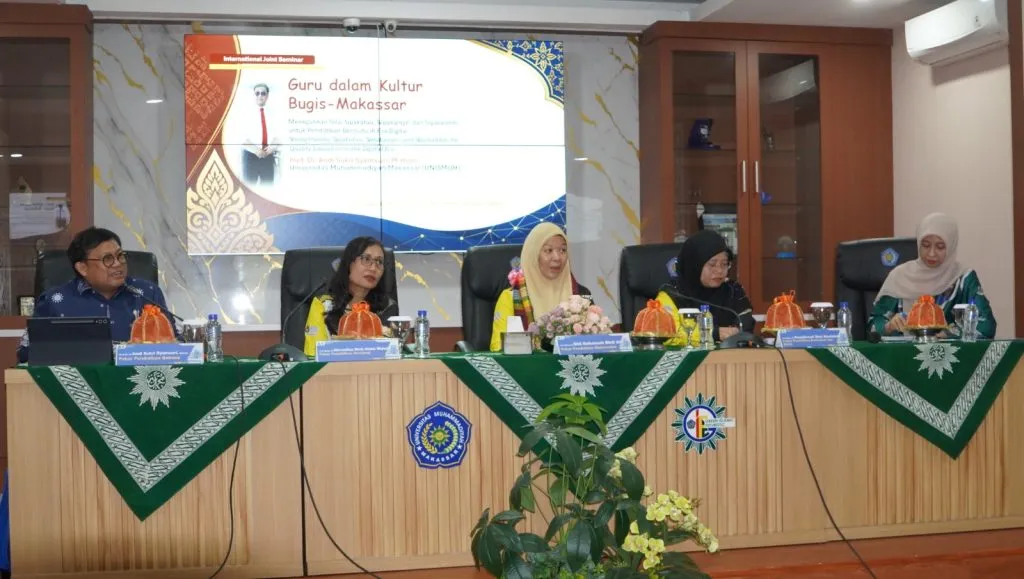
According to Prof. Andis, teachers are the figures closest to students in the education system. Therefore, educational quality still heavily depends on teachers' ability to understand students, provide reflection, and create a safe and meaningful learning environment.
He stated that digital technology can open educational access, but it does not automatically make education more humane. Teachers must still ensure that technology is used to support pedagogical relationships, not replace the presence and role of educators.
“In this digital era, we must place digital tools as instruments. So, it should not be that we get digital tools first and then look for learning objectives. That is not allowed,” said Prof. Andis.
Prof. Andis also touched upon the global challenge of teacher shortages. He mentioned that the world needs 44 million teachers by 2030, so teacher training institutions need to prepare future teachers who are professional, ethical, and capable of using technology wisely.
In the context of education, Prof. Andis said that technology can strengthen sipakatau, sipakainge, and sipakalebbi. Technology can help teachers understand students' needs, provide feedback, and create inclusive learning spaces if used based on clear learning objectives.
“A true teacher is not the one who uses technology fastest, but the one who uses it most wisely to humanize, remind, and honor,” said Prof. Andis.
Meaningful Curriculum
Prof. Madya Dr. Norazilawati binti Abdullah discussed curriculum transformation, pedagogy, science, technology, and assessment. She explained that educational change must not stop at superficial changes, such as replacing terms without altering the learning ecosystem.
Norazilawati stated that educational transformation needs to be designed holistically from the start. Curriculum, content, pedagogy, technology, assessment, and students' social needs must be interconnected so that learning is truly meaningful.
“Every time we teach, the first thing is the objectives to be achieved. The others, for example, pedagogy, are the methods or delivery context,” said Norazilawati.
According to Norazilawati, teachers should start learning from the objectives or outcomes they want to achieve. After that, teachers choose the most suitable methods, technologies, and assessment strategies based on students' needs.
She emphasized the importance of inquiry-based science learning. Children and adolescents today, she said, are more easily engaged when learning involves experiments, proof, and space for questioning.
Norazilawati also reminded that education must not only produce cognitively intelligent students but also those lacking in values and ethics. According to her, all teachers are responsible for instilling good values, not just religious or moral education teachers.
She gave examples such as teachers needing to habituate students not to throw trash randomly, not to use foul language, and not to engage in bullying. These values, according to Norazilawati, must be present in all subjects because education's role is to shape whole individuals.
Regarding assessment, Norazilawati explained school-based assessment practices in Malaysia. She stated that assessment should not only focus on exams but must also cover cognitive, affective, and psychomotor aspects.
Fun Numeracy
Prof. Madya Dr. Siti Rahaimah binti Ali presented a perspective on mathematics and numeracy education. She opened her presentation by asking participants about their impressions of mathematics, then highlighted the persistent belief that mathematics is a difficult and intimidating subject.
According to Siti Rahaimah, fear of mathematics needs to be reduced through enjoyable learning. Numeracy, she said, should be introduced as part of daily life so that students do not feel distant from mathematical concepts.
“We reduce the fear and intimidation of mathematics by making it more fun, more enjoyable, and more embedded in students' hearts,” said Siti Rahaimah.
She explained that her extensive experience in education led her to develop a gradual numeracy learning model. This model allows students to assess their own understanding level, especially on topics often considered difficult, such as fractions.
Siti Rahaimah also discussed the development of gamified learning media via mobile phones. According to her, both children and adults are highly connected to devices, so educators need to direct this habit into meaningful learning activities.
She stated that educational games can serve as an entry point to make mathematics more relatable to children's world. In this way, technology becomes not just entertainment but a tool for instilling numeracy concepts.
Siti Rahaimah also opened the possibility of follow-up activities together with Unismuh Makassar. She mentioned potential community service or social responsibility programs for children on the outskirts of Makassar who are less interested in mathematics.
Technology Ethics
Prof. Madya Dr. Norwaliza binti Abdul Wahab highlighted the integration of science, technology, social aspects, and humanism in future education. She stated that these four elements cannot be separated because 21st-century education must prepare students to live in a complex society.
According to Norwaliza, science is important for global competitiveness, technology is important for supporting learning, social aspects are important for building community life, and humanism is crucial to ensure education does not lose its values. She emphasized that education must not produce students who are technologically competent but lack empathy.
“Even if we use technology, do not forget to infuse values into every lesson, even when using artificial intelligence,” said Norwaliza.
Norwaliza stated that artificial intelligence or AI can help accelerate information access and learning material preparation. However, AI lacks human dimensions, so teachers and lecturers must still instill ethics, empathy, and academic responsibility.
She also highlighted the use of AI in student assignments. According to Norwaliza, students may use AI as a guide, but it is unethical to completely hand over AI-generated work without understanding and taking responsibility for its content.
“If you want to use AI, that's fine, but be ethical. What I mean is we ask AI to provide us with guidance, not to complete 100 percent of the assignments using AI,” she said.
Norwaliza also reminded the importance of considering students' socio-economic backgrounds. Students or learners with better devices and technology access can produce neater digital assignments, while those with limited devices may produce work of different quality.
According to Norwaliza, educational assessment should not rely solely on the final product. Lecturers and teachers need to look at the process, effort, social context, and students' ability to explain their ideas.
She also emphasized the importance of local culture in education. No matter how advanced the technology, she said, it must not cause students to lose their cultural identity as Makassar, Bugis, Malay, or part of other local communities.
Mindset
In the Q&A session, a participant, Syamsul Bakri, a lecturer in Sports Coaching Education (PKO) at Unismuh, asked about how to change students' mindset so they do not just attend classes, complete assignments, and graduate as ordinary bachelor's degree holders. The question was linked to the job market's demand for mastery in science, technology, AI, communication, and networking.
Addressing the question, Norwaliza stated that lecturers need to understand students' backgrounds before expecting high achievements. Some students, according to her, may not yet have a strong technological and academic foundation due to previous limited experiences.
She suggested that lecturers design assignments progressively with a scaffolding approach. In the initial stages, lecturers can strengthen basic understanding, then gradually increase the assignment level toward analysis, synthesis, creation, and innovation.
“We build structures; if the foundation is weak, it will collapse,” said Norwaliza.
Seminar moderator, Dr. Salwa, summarized that technology and AI can bring many conveniences, but cannot replace the figure of a teacher or lecturer who is capable of humanizing, reminding, and honoring students. She also emphasized that teachers must not just be content deliverers but must make an impact on students.
This event became part of strengthening the academic cooperation between Unismuh Makassar and UPSI Malaysia. Through the seminar, both higher education institutions are expected to expand collaboration in education, research, community service, curriculum development, student exchange, and value-based learning innovation.
Sustainable Development Goals



Related News
Prodi Pendidikan Matematika Unismuh Gelar Kuliah Tamu, Hadirkan Akademisi UPSI Malaysia
07 Jul 2026
Prodi Pendidikan Matematika Unismuh Dorong Pembelajaran Digital di Thailand
25 Jun 2026
Prodi Pendidikan Matematika Unismuh Dorong Pembelajaran Digital di Thailand
21 Jun 2026